Summary for Those in a Hurry
Key finding: Your brain doesn’t reward expensive gifts — it rewards surprise. A neuroscientific mechanism called Reward Prediction Error (RPE) causes expected Christmas gifts to trigger minimal dopamine response, while an unexpected gift on a random Tuesday unleashes a biochemical explosion of happiness.
Why it doesn’t work: Hedonic adaptation gradually dulls the joy from regular rituals. Luxury gifts every Christmas become the “new normal,” and the brain stops perceiving them as a reward.
The solution: A “micro-dosing” happiness strategy — divide your budget into smaller, unexpected gestures throughout the entire year. Research by Elizabeth Dunn (UBC) and Michael Norton (Harvard) confirms that frequency and unexpectedness have a greater impact on happiness than the size of the gift.
Based on: 8 scientific sources
Giving and receiving gifts is one of humanity’s oldest social rituals. While modern society focuses on the material value of gifts during fixed holidays, neuroscientific research suggests that this approach directly contradicts how the human brain is biologically wired to experience joy.
According to studies of dopamine pathways, expected rituals trigger a state of “metabolic calm” in the brain rather than euphoria. The true biochemical explosion of happiness is reserved for moments the brain cannot predict.
The Neurochemistry of Expectation: The RPE Mechanism
At the center of our modern understanding of motivation stands the neurotransmitter dopamine. For decades, it was mistakenly regarded as a simple “pleasure molecule.” However, the groundbreaking work of Professor Wolfram Schultz at the University of Cambridge [1] demonstrated that dopamine neurons function as a detector of informational value and surprise.
We define this process as Reward Prediction Error (RPE) — the difference between the reward we receive and the reward we expected based on experience.
🧠 Reward Prediction Error (RPE)
Christmas Gift
Expectation (V) is high → even an expensive gift produces δ close to zero. Brain: "routine fulfilled"
Unexpected Tuesday
Expectation (V) is zero → even a small gift produces a massive positive δ. Brain: "this is amazing!"
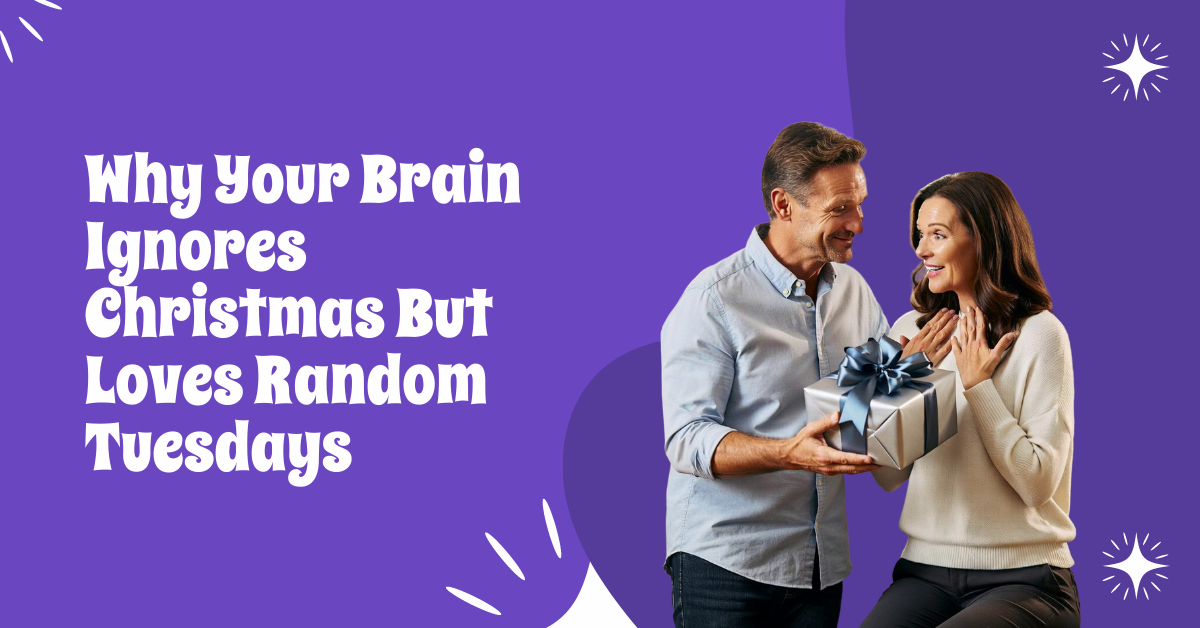
What does this mean in practice? If your expectation (V) is high — for example, seconds before unwrapping a gift under the Christmas tree — the value of δ approaches zero, even if the gift is objectively expensive. The brain interprets it as “routine fulfilled.” In contrast, an unexpected gift on a random Tuesday creates a massive positive imbalance, leading to a profound emotional impact.
Hedonic Adaptation: Why “More” Doesn’t Mean “Better”
The second pillar behind the failure of traditional gifts is hedonic adaptation. This psychological process, first described by Brickman and Campbell in 1971 [2], describes our ability to quickly return to a baseline level of happiness even after significant positive changes.
The classic 1978 study comparing lottery winners and people who had suffered serious accidents revealed that after a certain period of time, the happiness level of lottery winners did not differ from the control group [3]. Once the “new normal” (e.g., luxury gifts every Christmas) becomes a stable feature of the environment, the brain stops perceiving it as a reward and begins treating it as a baseline.
📉 Hedonic Adaptation in Practice
The brain stops perceiving regular gifts as rewards -- they become the "new normal"
Comparison: Gift-Giving Effectiveness
📊 Expected Gift vs. Unexpected Gift
The “Micro-Dosing” Happiness Strategy
Research by Elizabeth Dunn (UBC) and Michael Norton (Harvard), summarized in their publication Happy Money [4], offers a scientifically backed alternative. Instead of large, isolated gifts, they propose a strategy focused on frequency and the typology of experiences.
Their research identified five fundamental principles of “happy spending”:
1. Experiences over things
Experiences create memories that become idealized over time, while material goods depreciate.
2. Make it a treat
Limiting access to a pleasure (scarcity) increases its future value.
3. Buy time
Investing in services that eliminate stressful tasks directly increases life satisfaction.
4. Pay now, consume later
Delayed consumption allows for a longer period of anticipation -- a dopamine "appetizer."
5. Invest in others
Prosocial spending demonstrably increases the giver's happiness more than spending on oneself [5].
Reciprocity and Social Influence
According to Robert Cialdini, a renowned expert on the psychology of influence, reciprocity (the urge to return a gift) is one of the most powerful social drivers [6]. However, for a gift to build a relationship rather than feel like manipulation, it must meet three criteria:
🤝 Three Criteria for Effective Reciprocity
Research in practice: Experiments in restaurant settings showed that an unexpected, personalized gift (e.g., a candy with the bill accompanied by a personal comment) increased tips by 23 %, while simply handing out sweets had minimal effect [7].
The Role of GiftWeGo: AI as the Architect of Relationship Chemistry
In the modern world, our ability to be spontaneous runs into the barrier of so-called Intentional Load — the mental burden arising from constant planning. Studies show that unfinished intentions deplete the brain’s executive functions [8].
🤖 How GiftWeGo Integrates Neuroscience into Practice
Managing "Just Because" moments
Algorithms help set up random reminders that prevent the formation of fixed predictions in your partner's brain. Maximizing positive RPE.
Minimizing cognitive load
By offloading the task of "thinking up and planning" to AI, your capacity is freed for actually experiencing the relationship. Elimination of Intentional Load.
Preventing habituation
The system tracks history to ensure gift variability, keeping the recipient's dopamine system perpetually sensitive. Actively combating hedonic adaptation.
Conclusion and Recommendations
Neuroscience tells us that the greatest gift we can give someone is disrupting their routine with a kindness they could not have predicted.
To strengthen your relationships, we recommend:
Break the annual cycle
Divide your budget from major holidays into smaller gestures throughout the entire year. Frequency beats magnitude.
Prioritize unexpectedness
A gift on a random Tuesday has greater biological value than an expensive gift under the tree. Surprise is the key to dopamine response.
Leverage technology
AI tools for gift management are not a sign of lacking emotion, but a strategic decision to keep relationship chemistry a priority.
Your next step? Stop waiting for Christmas. Try the AI gift advisor and plan your first “Just Because” moment this very week. Your brain — and the brain of your loved one — will thank you with a dopamine explosion that no Christmas gift could ever match.
Sources and Further Reading:
Academic Studies:
-
Schultz, W. (2016). Dopamine reward prediction error coding. Dialogues in Clinical Neuroscience, 18(1), 23-32.
-
Brickman, P., & Campbell, D. T. (1971). Hedonic relativism and planning the good society. Appleton-Century-Crofts.
-
Brickman, P., Coates, D., & Janoff-Bulman, R. (1978). Lottery winners and accident victims: Is happiness relative? Journal of Personality and Social Psychology, 36(8), 917-927.
-
Dunn, E. W., & Norton, M. I. (2013). Happy Money: The Science of Happier Spending. Simon & Schuster.
-
Dunn, E. W., Aknin, L. B., & Norton, M. I. (2008). Spending money on others promotes happiness. Science, 319(5870), 1687-1688.
-
Cialdini, R. B. (2009). Influence: Science and Practice. Pearson Education.
-
Strohmetz, D. B., et al. (2002). Sweetening the Till: The Use of Candy to Increase Gratuities. Journal of Applied Social Psychology, 32(2), 300-309.
-
Rajani, R. (2020). Intentional Load: The Cognitive Burden of Deferred Tasks. Medium Research.
Ondřej is a developer specializing in building AI-powered applications. He creates digital solutions that simplify everyday life – from GiftWeGo to the marketing platform ProSignify and practical tools like the Fast English Chrome extension. Previously, he actively collected projects through Smuton.cz. Articles on this blog combine his personal expertise with AI research to deliver relevant and useful insights to readers.
Not sure what gift to choose?
Our AI advisor will help you find the perfect gift based on the recipient's interests and personality. Just a few clicks!
Try AI advisor for free